They Have Bigger Guns Than We Do
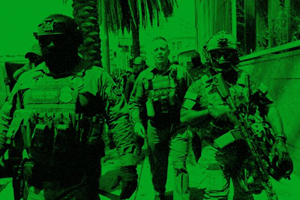
The mayor of Minneapolis was interviewed yesterday and said "The question that you're basically asking is, can our cops arrest them? From a legal perspective, yes. From a practical perspective...they have bigger guns than we do."
If Mayor Frey is serious, that’s a public admission of a breakdown in the hierarchy of authority between local government and the federal state.
When the mayor says that local law enforcement could legally arrest federal agents but won’t because those agents have “bigger guns,” he’s saying a lot.
Frey is acknowledging that the legal question is settled. Local law enforcement does, in fact, retain arrest authority when federal agents violate state or local law. No grey area. Frey is explicitly rejecting the idea that ICE or DHS is untouchable under law. That should be good. But…
Frey is also drawing a sharp line between law and power. The reason local authorities aren’t acting isn’t uncertainty, confusion, or procedural delay. It’s fear of escalation. That’s an extraordinary thing for an elected executive to say out loud. It tells you that the city believes any attempt to enforce the law against federal agents would be met with armed resistance or rapid federal retaliation. Probably both. Frey is signaling that the federal presence isn’t operating as cooperative law enforcement, it’s operating as a force that would overpower local institutions if challenged.
It signals that federal agencies are operating beyond meaningful local consent. In a healthy federal system, local and federal law enforcement may disagree, but they coordinate. They negotiate. They deconflict. That is obviously not happening here. Frey said so. Walz said so. Ellison and Moriarty said so. When local leadership publicly frames the issue as one of firepower rather than jurisdiction, it means coordination has collapsed. The city is no longer a partner. It’s a bystander within its own borders. (That feels accurate.)
This is a warning, not just a description. Mayor Frey is telling residents that the city can’t protect them from federal action, even if that action is unlawful. That shifts the psychological terrain. When local government admits it can’t or won’t enforce the law because fears armed escalation, normal accountability mechanisms are no longer functioning at the local level.
From an intelligence perspective, the language conveys the federal agencies’ paramilitarized posture. Law enforcement doesn’t usually think in terms of comparative armament when discussing arrest authority. Soldiers do. Insurgents do. Occupying forces do. The fact that a mayor is thinking this way acknowledges that federal agents are visibly armed, tactically postured, and behaving in a way that communicates dominance rather than service.
It’s also an attempt to dodge responsibility. By framing the issue as practical rather than moral or constitutional, Frey is preemptively explaining why nothing will be done. It’s damage control. He’s telling you that even when something goes wrong, when someone is hurt or killed, the city will claim it had no ability to intervene.
That’s what it sounds like when civilian governance is subordinated to coercive force.
It doesn’t mean martial law has been declared. It does mean that in at least one major American city, an elected mayor believes that asserting the rule of law against federal agents could trigger an armed confrontation he can’t win.
That’s not normal. It’s not stable. And it’s not a rhetorical slip. It’s a quiet acknowledgment that power, not law, is currently setting the boundaries of action.
OK fine. But how bad is that, really?
Bad. Very bad. Not abstractly bad, not rhetorically bad. Structurally dangerous.
When local government admits it won’t enforce the law because it’s afraid of armed escalation, that’s a threshold moment. Democracies survive all kinds of dysfunction, hypocrisy, and corruption. What they historically don’t survive is the normalization of force as the final arbiter between levels of government.
Why does that matter? Because it means the rule of law has become conditional.
Law is only law if it can be enforced without fear. The moment enforcement depends on who has more weapons, the system shifts from legal authority to coercive authority. From policing to domination. Once that happens, every other legal safeguard becomes weaker, because everyone involved knows that the ultimate check is no longer courts or elections. It’s firepower.
It signals the collapse of civilian control at the local level.
Local government exists to mediate power. Cities are supposed to be the closest layer of democratic accountability. When a mayor says “We have authority but we can’t exercise it because we would lose a fight,” he is acknowledging that his jurisdiction has been overridden by force. That’s not federalism functioning. That’s federal supremacy enforced through intimidation.
It creates a permission structure for abuse.
You don’t need explicit orders for abuse to occur. You only need actors to believe they won’t be stopped. If federal agents know that local police will stand down rather than risk escalation, restraints weaken. Actions that should be moderated by fear of arrest, investigation, or public confrontation become easier. Become common. Impunity forms through repeated non-response. Women are executed in their cars.
It breaks the feedback loop that prevents violence.
In a functioning system, escalation is deterred because every actor knows someone else has both the authority and the will to intervene. Deterrence disappears, escalation becomes more likely, not less. Fear of violence today makes violence tomorrow more probable, because no one believes boundaries will be enforced.
It moves political conflict into a security frame.
Once elected officials start talking about “bigger guns,” the language of governance has failed. Political disagreements are no longer being resolved through negotiation, courts, or legislation, but through calculations of force. That’s a classic warning sign in intelligence analysis. It’s how democracies slide, not into instant dictatorship, but into zones where normal rules no longer apply.
It teaches the public a dangerous lesson.
Citizens hear that statement and think: the city can’t protect them when the federal government decides to act aggressively. That erodes trust not just in local leadership, but in the entire idea that rights are enforceable. People adapt in unhealthy ways. Some withdraw. Some comply out of fear. Some radicalize. None of those outcomes are good for stability.
It’s a line that healthy systems work very hard not to cross, and almost never say out loud.
Public admissions like this tend to appear in three contexts:
– During periods of intense federal overreach.– During civil rights flashpoints where local authorities are sidelined.– During the early stages of democratic backsliding, before formal legal changes catch up to reality.
What makes this moment especially concerning is that it is being articulated casually, almost resignedly. “This is how things are now.”
And that’s the real danger.
Not that someone said it. But that it was said, on camera, by a sitting mayor, without triggering an immediate constitutional crisis.
The system doesn’t collapse immediately when fear replaces law. It hollows out. Quietly. Selectively. Until one day people realize that what they thought were guarantees were really just assumptions, and assumptions only hold until someone decides they no longer do.